Research Article | | Peer-Reviewed

Harnessing Knowledge Management Infrastructure Capability for Valuable Organizational Results: The Moderating Role of Regulatory Framework

Received: 25 January 2026     Accepted: 9 February 2026     Published: 28 February 2026
Views:       Downloads:
Abstract

Deposit-Taking Savings and Credit Cooperative Societies (DT-SACCOs) are essential drivers of economic development through enhancing financial inclusion and fostering economic growth within communities. Despite their importance, DT-SACCOs in Kenya are facing declining performance. This study investigated whether the regulatory framework moderates the relationship between knowledge management infrastructure capability and the organizational performance of DT-SACCOs in Kenya. In this study, knowledge management infrastructure capability is recognized as a strategic tool that is designed to make organizational performance better. Given that DT-SACCOs operate within a heavily regulated environment, it is hypothesized that regulatory framework influences how investments in knowledge management infrastructure capability translate into organizational performance improvements. Anchored in the resource-based view theory, knowledge-based view theory and the balanced scorecard model with support from open systems theory to explain the moderating influence of regulation, this study adopted descriptive and explanatory research designs under a positivism philosophy. The research targeted 176 DT-SACCOs in Kenya, focusing on 880 managers across finance, human resources, ICT, legal and marketing at their headquarters. Using stratified proportional sampling, 275 respondents from 55 randomly selected DT-SACCOs participated in the study. Data was collected via a semi-structured questionnaire, with reliability confirmed through Cronbach’s Alpha coefficients exceeding 0.7. Validity was ensured through face, content, and construct assessments. Descriptive statistics outlined the characteristics of study variables, while multiple regression analysis examined the relationships among knowledge management infrastructure capability, organizational performance, and the moderating role of the regulatory framework. Findings revealed that KMIC significantly enhances organizational performance in DT-SACCOs and that the regulatory framework positively moderates this relationship. The study advises DT-SACCOs to prioritize recruiting skilled managers, fostering transparent and accessible service environments, and focusing employee training on quality service delivery. Additionally, it recommends that DT-SACCOs maintain flexibility in managing resources to effectively capitalize on emerging business opportunities.

Published in Journal of Business and Economic Development (Volume 11, Issue 1)
DOI 10.11648/j.jbed.20261101.12
Page(s) 16-30
Creative Commons

This is an Open Access article, distributed under the terms of the Creative Commons Attribution 4.0 International License (http://creativecommons.org/licenses/by/4.0/), which permits unrestricted use, distribution and reproduction in any medium or format, provided the original work is properly cited.

Copyright

Copyright © The Author(s), 2026. Published by Science Publishing Group

Keywords

Knowledge Management Infrastructure Capability, Organizational Performance, Regulatory Framework, Deposit-Taking Savings, Credit Cooperative Societies in Kenya

1. Introduction
Superior performance is fundamental to organizations as a result, making it the most sought-after outcome and a critical factor in evaluating organizational actions . According to Shurie, Kilika, & Muchemi , performance of an organization is key in determining the life of an organization and its viability for its stakeholders. The breakthrough of businesses is dependent on their performance and consequently, it lies at the center of any organization’s wellbeing . According to Tomal and Jones , organizational performance can be understood as the actual yield compared to the intended outcomes encompassing financial, non-financial or both measures, with the capability of evaluating the levels regarding which organizational vision can be realized . Consequently, it is understood as an extent in which organizations which are viewed as a social system equipped with resources that are a blend of both tangible and intangible resources and competencies, achieve their short-term objectives and long-term objectives .
Despite this understanding, there is no consensus on the definition, understanding and explanation of organizational performance among strategic management scholars . Historically, the measuring of organizational performance has been limited to the financial measure due to the ability of indicators being measured with the help of published reports with indicators such as return on investment, assets, sales, equity and other profit related indicators , However, some other scholars have advocated for the need to employ non-financial indicators as they are able to offer better predictors to the overall goals of an organization and can be measured through subjective information that is gathered from key informants within the organization . In order to appreciate both dimensions, some scholars have advocated for the integration of both performance measures in order to balance the overreliance of the financial measure of evaluating the performance of organizations through the introduction of the balanced scorecard ,
Studies done on savings and credit cooperative societies have relied on both non-financial and financial dimensions of performance . Despite this, scholars have critiqued the financial measure as a dimension that is not appropriate for organizations with non-profit call as well as those which are studied under knowledge-based studies . Studies that have used the non-financial measures have conceptualized an organization’s performance through stability, effectiveness, sustainability and efficiency . SACCO supervision annual report conceptualized effectiveness based on the DT-SACCOs’ processes manifested through management information systems such as on-line loan application systems and customer feedback through set technology systems. Efficiency was conceptualized in terms of prudent management of DT-SACCO input and output to deliver higher quality service to members . Stability was conceptualized based on the management confidence manifested by reduced employee turnover in DT-SACCOs and sustainability measured in terms of DT-SACCOs’ asset growth .
Consequently, this study employed non-financial measures to assess organizational performance and selected several key indicators to include effective process, member compliance, membership growth and quality service delivery as measures of organizational performance with the view that these indicators provide more inclusive understanding of how knowledge management infrastructure capability influence the ultimate performance of DT-SACCOs. Knowledge management infrastructure capability is one of the dimensions of knowledge management capability and its significance is on its ability to help in building and maintaining the general organizational capabilities which are shared with an organization’s functions . Different scholars have defined it differently to include the facilitating conditions which are offered by organizations to enhance knowledge management process such as structural infrastructure capability, technological infrastructure capability and cultural infrastructure capability .
Structural infrastructure capability refers to ability of operational and command structures in organizations to support and enhance knowledge management and they include, the physical and the hierarchy layout of an organization . The significance of this capability is on its belief that organizational structures should be appropriate to the organization for easy adaptation to the dynamic environment , and that they must be flexible to encourage knowledge sharing and collaboration . For this study, structural infrastructure capability was conceptualized as the ability of the organization’s design to enhance knowledge management through command structures, hierarchical layout, physical layout and structures of operations of the DT-SACCOs.
Technological infrastructure capability refers to a system’s ability to determine how knowledge travels and can be accessed within an organization . Technological infrastructure capability has a core position in the knowledge management framework by helping in sharing knowledge and storing the existing knowledge for easier retrieval . For this study conceptualized technological infrastructure capability as the ability of the organization’s hardware and software systems to determine how knowledge is accessed and disseminated through web-browsers, expert software, organizational portal and office automation in the DT-SACCOs.
According to Oliver & Kandadi , cultural infrastructure capability is a way of organizational behavior that enables knowledge to be created, shared, and used in order to achieve the goals of an organizational. According to Mubarak & Sabraz , culture is unique to each organization and it is the constructive culture which raises the levels of members’ corporation and coordination between the organization’s structures and organizational performance. Scholars such as Sin & Tse , identified cultural infrastructure capabilities to include values that incorporate quality service delivery, consumer orientation and innovation. For this study therefore, cultural infrastructure capability was measured in terms of intra-organizational coordination among employees, consumer orientation, innovation and learning value systems in the DT-SACCOs.
According to Ndumia , business organizations operate in an open system. An open system is one that regularly exchanges feedback with the external environment . Deposit-taking SACCOs’ regulatory framework in Kenya was introduced from June 2010 and it heralded the formal recognition and incorporation of the SACCO sector to the national formal financial industry which included banking, insurance, capital markets and pensions sector . The regulatory framework encompasses the established guidelines and operational standards that organizations must comply with to sustain their legitimacy and continued operation . According to Wandiga , regulatory framework comprises of forces arising from the organization’s industry, the regulation set out by the state, affiliations as well as the operating procedures.
The forces emanating from the regulatory framework can either favor or hamper value generation operations of firms . Regulatory framework has been used by several studies as a moderator with different measures. For this study, regulatory framework and its dimensions as spelt out by Wandiga which include, industry regulation as indicated through Sacco Societies Regulatory Authority (SASRA), government policies by means of the SACCO societies act and policy guidelines as advanced by Kenya Union of Savings & Credit Co-operative as well as the DT-SACCOs’ code of operations that guide the day-to-day operations and conducts of employees and institutional ethos were used to measure the regulatory framework.
Savings and credit cooperative societies remain the most dominant member of the financial cooperatives alongside investment and housing cooperatives because they collect funds from members to invest on their behalf . Globally, the savings and credit cooperative societies have the mandate of providing financial services and products to their members and they assume different names such as Credit Unions, Cooperative Banks and SACCOs . Therefore, a SACCO can be defined as a membership-based socio-economic enterprise in which its customers come from its members . In Kenya, the Savings and Credit Cooperative Societies are divided into both deposit-taking and the non-withdrawal deposit-taking with their operations requiring a license and adherence to regulatory oversight from the regulator in order to ensure their stability and integrity .
According to SACCO supervision annual report , there are 176 SACCOs registered to carryout deposit taking business in Kenya and are clustered according to their common bond based on their founding objective. They include 49 agriculture-based, 25 community based, 82 government based and 21 private sector-based DT-SACCOs all spread across 40 counties in Kenya with Nairobi City County leading with 46 DT-SACCOs and consequently control about 26 percent of the DT-SACCOs . According to Kenya Financial Stability Report, 2021 and SACCO supervision annual report , the deposit-taking SACCO sector is currently facing a decline in performance as seen in decline in the usage of products and services due to processes, service delivery challenges, slow membership growth, increased dormancy default rate among . To mitigate against the performance trends, these DT-SACCOs have endeavored to invest in strategic management with knowledge management being one of such strategic management measure as a result of the intensity of knowledge requirement and usage in these organizations . DT-SACCOs hold knowledge through products and services, legal and compliance requirements, operations, relationships and institutional memory . To enhance knowledge management activities, DT-SACCOs have invested in technology, organizational structure and culture that are strategic and are documented to provide the much-needed capability for enhanced outcome . Past studies have identified culture as key to cooperation and coordination in DT-SACCOs ; technology to be key transporting and storing knowledge in DT-SACCOs with popular technological tool for knowledge management including computers, mobile phones and software systems and the organizational structure to be significant in the organizational performance of DT-SACCOs.
1.1. Statement of the Problem
Deposit-Taking Savings and Credit Cooperative Societies in Kenya have a significant role in the financial sector through savings mobilization and increasing of credit access. Despite this important role, there is a marked decline in their contribution to the country’s gross domestic product (GDP) from 6.67 percent in 2021 to 6.43 percent in 2023 and a marked decline in performance of the DT-SACCOs aggravated by a slow growth in product uptake, and declining membership. For example, in 2023, 29 DT-SACCOs reported a decrease in membership, with eight of these societies losing a total of 20,578 members over a period of two years, that is 16,389 in 2022 and an additional 4,198 in 2023 .
Despite the existing research, there is significant conceptual, contextual and empirical research gaps that exist thereby handicapping the generalizability of findings to DT-SACCOs in Kenya. Available literature indicates that most studies related to this subject have been done on knowledge management capability and performance of organizations with a focus on process capability and performance . Therefore, this study aimed at identifying the effect of the knowledge management infrastructure capability on the organizational performance of DT-SACCOs. Secondly, available studies have not included the moderation effect of organizational agility with the few that have used this variable have been on the broader relationship of knowledge management capability and the performance of organizations . Moreover, past studies on DT-SACCOs have measured performance using financial indicators such as profitability with limited studies using non-financial dimension of organizational performance . There is also scope and context limitation with most related studies having been done in varied scope and context such as hospitals, private companies with few conducted on Deposit-Taking Savings and Credit Cooperative Societies .
Furthermore, this study has also identified several methodological gaps from the reviewed studies hence a reason to replicate the research. Most of the reviewed studies have used a single research design with descriptive design standing out . Subsequently, Sivagiri and Tsetim, Ochanya and Agema have used non-probability sampling technique as well as generating hypothesis for testing. This sampling design is known for generalizability challenges due to high level bias. Therefore, this study sought to interrogate the moderating role of regulatory framework on the relationship between knowledge management infrastructure capability and organizational performance of DT-SACCOs in Kenya.
1.2. Research Objective
The study sought to investigate the moderating role of regulatory framework on the effect of knowledge management infrastructure capability on organizational performance of the Deposit-Taking Savings and Credit Cooperative Societies in Kenya.
1.3. Research Hypothesis
Ho: Regulatory framework does not moderate the effect of knowledge management infrastructure capability on organizational performance of the Deposit-Taking Savings and Credit Cooperative Societies in Kenya.
Ha: Regulatory framework moderates the effect of knowledge management infrastructure capability on organizational performance of the Deposit-Taking Savings and Credit Cooperative Societies in Kenya.
2. Theoretical Review
2.1. Resource Based View Theory
Resource Based View (RBV) theory was propagated by Penrose in 1959 and provided a reason to show the causal relation among organizational resources, capabilities, and competitive advantage. Later on, this theory was developed by additional strategic management scholars who including Wernerfelt in 1984 and Barney in 1986. This theory argues that different capabilities can lead to difference in the success of organizations despite similarity in the business environments . According to RBV, an organization is an administrative framework consisting of a bundle of resources that are tangible, intangible or both and are responsible for the organization’s performance . According to Pearce , RBV provides a basis for determining an asset, capability or competence as well as providing a guideline of determining the resources that generate sustainable competitive advantage within an organization.
According to this theory, knowledge management infrastructure capability is a strategic resource that when utilized correctly will raise the organizational potential to bring out superior organizational performance. This theory helps in explaining competitive heterogeneity based on the premise that competitors who are close to each other have different resources and capabilities . The relevance of RBV to this study was seen in its extension in explaining how knowledge management infrastructure capability generates strategic advantage for organizations . This theory therefore provided a guideline that is important in helping organizations to explain the link between knowledge management infrastructure capability as a valuable asset and the potential they bring to an organization leading to the organization’s performance. Thus, this study was anchored on RBV Theory. In essence, social science researchers, particularly those in management-related fields, have utilized the resource-based view as a theoretical lens for anchoring empirical investigations in different settings .
2.2. The Knowledge Based View
Knowledge based view was propagated by Kogut and Zander in 1992. This theory holds that organizations exist to manage knowledge in order to develop their competitive advantage. Further, competitive success can be realized from an organization’s capacity to innovate assets that are knowledge based and have the potential of generating core organizational competencies . Additionally, this theory avers that knowledge is the key driver in the generation of organization’s dynamic capabilities convertible into products or services in an organization and that knowledge is the most premium resource for any organization . Therefore, knowledge management capability can primarily lead to the development of durable competitive advantage directly and indirectly through strategy .
Worth noting, unlike the resource-based view theory that sees knowledge as a generic resource, knowledge-based view theory supports the view that organizations exist for the intent of creating, transferring, and transforming knowledge into competitive advantage . Additionally, Zhao emphasizes that the importance of knowledge-based view comes in as an important theory for strategist and researchers. In the activity of improving organizational performance through knowledge management, organizations need to have the much-needed knowledge management infrastructure capability. For this study, this theory anchored the structural infrastructure capability, technological infrastructure capability and the cultural infrastructure capability.
2.3. Open Systems Theory
The open system theory was developed by Ludwig Von Bertalanffy in 1950 and is concerned with the relationship between organizations and the environment in which they conduct their business . The focus of this theory is on the possibility of organizations to fit into the changes that occur in their environment . To note, this environment is external and includes a wide range of needs and influences that have the potential of affecting the organization, without the organization’s ability to directly control it and they include political, economic, ecological, societal and technological forces .
Cognizant of the argument by the supporters of open systems theory that organizational outcome is a factor of the influence of the happenings in their external environment; studies have found have found out that influence from the forces arising from the organization’s industry together with the regulation set out by the state regulation, affiliation and operation has a major role in the organizational outcome . Legislative forces have been highlighted as an important external force in the influence of an organizational outcome . Regulatory framework is one of the main manifestations of legislative forces and it comes into shape how an organization behaves in a business environment through influencing the outcome of any intervention by an organization .
This theory is important when the focus of the organization is on performance since exchange of feedback is key for a highly effective organization with its external environment .
2.4. The Balanced Scorecard
This model was laid out by Kaplan and Norton in 1992 as integrated measures that sought to allow for a whole and integrated view of an organization’s outcome . The key role of the balanced scorecard was to supplement traditional financial measures which concentrated on looking at how an organization looks at shareholders . The focus on the financial dimension was viewed as an inadequate perspective since organizations ended up making strategic decisions that turned out to be bad while pushing for an increase in the bottom line which came at the cost of organizational goals . Balanced scorecard therefore is a set of dimensions that give top organizational leadership a quick and wholesome view of the business . According to Isorite , balanced scorecard was conceived from the background that organizations fail to have relevant tools for managing their qualitative assets such as customer satisfaction, the quality of the processes and organizational infrastructure.
According to Kaplan and Norton , balanced scorecard introduced a criterion that can be used to measure performance from more perspectives which included customer, internal business process, learning and growth. This theory further suggests that instead of financial performance being the focus, it should be the natural outcome as a result of balancing all the important organizational goals which interact to support excellent overall performance of the organization . Originally, this model was created as a measurement system that responded to criticisms about the unilateral measurement of the organizational performance by dividing an organization’s objective into financial perspective and operative perspective . This theory therefore will support the dependent variable.
Scholars have positioned this model as a strategic performance measurement model whose effective use can lead to a full approach to the identification of organizational performance and break the reliance on traditional financial indicators to measure performance singularly . To realize a bigger picture of performance, the non-financial measurements of organizational performance must be included, and the selected measures have to be relevant to the strategy of the organization . This has not been the case with the past studies on DT-SACCOs. Studies and industry reports have indicated that these organizations have tended to rely heavily on the financial measure with minimal interest in the other non-financial perspective . Scholars observe that financial data reflects an organizational past performance . This action has made these organizations keep on relying on their past performance in order to offer the business performance projection. This hindsight approach has had an impact on the organizational performance of these DT-SACCOs. The significance of this theory was in supporting the outcome variable which is the organizational performance and consequently justified the adoption of non-finance related indicators of measuring performance.
3. Empirical Review
Kori, Muathe and Maina conducted a study to confirm the moderating effect of regulatory framework in the relationship between the strategic intelligence and the organizational performance of Kenya’s commercial banks with a study population of 40 commercial banks operating in Kenya and a theoretical foundation of both the resource-based view and offense-defense theories. A sample of 181 was proportionately selected using a stratified sampling procedure with primary data collected from the respondents in head offices and secondary data from the annual reports from Kenya’s central bank. Data analysis as done through descriptive and inferential statistics. The study established that both central bank and the commercial banks should develop and jointly put provisional rules in force that include liquidity, credit and foreign exchange risk management and at the same time put up a strategic intelligence practice that can make both organizations foresee threats, risks and opportunities in the banking environment.
Vianney, Iravo and Namusonge examined the moderating impact of legislative framework on practices of board leadership and the corporate governance performance of the public institutions in Rwanda. The study used both descriptive and explorative designs with a target population of 214 managers from 10 public institutions in Rwanda. The study used stratified random sampling to get a sample of 195 respondents from both the top and the middle level managers. The hypothesis was tested and found legislative framework to positively and significantly have a moderating effect on board composition practice and ethical practices while there was no effect of legislative framework on local advocacy. The current study was on DT-SACCOs in Kenya.
Wandiga investigated the role that the operations strategy has on the performance of the management consultancy firms in Nairobi with the moderating role of regulatory framework. For this study, regulatory framework was formulated in terms of the state control indicated by legal framework and professional body control indicated by ethics and standards. The study employed mixed study design by using both the descriptive and the causal designs with data collected using questionnaire. The study opined that regulatory framework is indeed prohibitive to consultancy business sector. That is, it affects the operations of the consultancy firms and consequently significantly affects performance. However, the current study operationalized regulatory framework inform of, code of operation, government policies, industry regulation and institutional ethos.
Oluoch, K’Aol and Koshal conducted a study to find out the effect of regulatory framework as a moderator in the existing relation between strategic leadership and financial sustainability of the non-governmental organizations (NGOs) in Kenya. This study used strategic leadership theory as the anchor theory and applied both descriptive and explanatory research designs. The study population consisted of 6,028 active local NGOs. The study selected a representative sample using a random sampling technique and collected data through a questionnaire. The correlation results established that strategic leadership had a significant link with financial sustainability. However, there was a poor fit of the model with the inclusion of the moderating variable and hence observed that regulatory framework had no moderating effect. However, the current study was conducted within the DT-SACCOs in Kenya.
Ali looked at the role of regulatory framework on performance of micro finance institutions within the West African Monetary Union (WAMU) following modifications to the rules and prudential ratios which included capital and liquidity. The study run econometric estimations out of which the results found that the application of the 2007 law did not bring any benefit to the performance of the microfinance institutions. This study gathered data over a period of 13 years, starting from 2002 to 2015. During this period, the minimum capital requirements significantly affected the financial performance of these organizations since they influenced the funds accumulation for investments. Further, the study maintained that the relation between minimum capital and performance was significant even when different indicators of performance and estimation methods were used. However, this study measured performance using the non-financial perspective.
Based on the reviewed literature, there exist differences in the operationalization of the variables under investigation. The study noted various contextual and methodological limitations in the existing studies. Various studies had contradictory results on whether regulatory framework moderated the relationship between knowledge management infrastructure capability and organizational performance of deposit taking savings and credit cooperative societies prompting need for this study.
4. Conceptual Framework
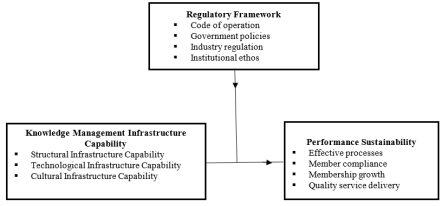
Based on the reviewed literature, the study developed the conceptual framework which outlined the relationship between knowledge management infrastructure capability (Independent variable) and organizational performance (Dependent variable) of deposit taking savings and credit cooperative societies in Kenya. It went ahead and connected regulatory framework (moderating variable) showing how it moderates the relation between knowledge management infrastructure capability and organizational performance of deposit taking savings and credit cooperative societies in Kenya.
Figure 1. Conceptual Framework.
5. Research Methodology
The study adopted positivism philosophy due to its interest in collecting data and testing hypothesis through statistical techniques as guided by , and that research is external to researcher and results are objective and not influenced by the researcher . The study used both descriptive and explanatory research designs due to their combined strength in delivering optimal research results . Linear regression analysis was used establish the variables’ relationship and predict their values including the moderation effect that regulatory framework plays on existing relationship between knowledge management infrastructure capability and the organizational performance of DT-SACCOs in Kenya . The study’s target population consisted of the 176 DT-SACCOs in Kenya with the study population consisting of 880 managers who are in-charge of the five functional areas which included finance, human resources, information and communications technology (ICT), legal and marketing and based in the DT-SACCO’s headquarters. Stratified proportionate sampling was used to identify 275 study respondents from 55 DT-SACCOs consisting of 31.25 percent of the DT-SACCOs. The 55 DT-SACCOs were picked using simple random sampling. A semi-structured questionnaire was used to collect data from 275 respondents. Reliability was confirmed through Cronbach’s Alpha, where a coefficient of 0.7 or higher denoted acceptable reliability, consistent with the guidelines of Tavakol and Dennick and widely adopted in social science studies . A pilot was done among the DT-SACCOs involving respondents who were not part of final respondents as recommended by Field . Face, content and construct validity were used to analyze validity of the tools. The results for reliability test were as shown in Table 1.
Table 1. Cronbach's Alpha Value.

Research Variable

Cronbach's Alpha

Decision

Structural infrastructure capability

0.791

Reliable

Technological infrastructure capability

0.776

Reliable

Cultural infrastructure capability

0.747

Reliable

Regulatory framework

0.843

Reliable

Organizational Performance

0.738

Reliable

Aggregate Score

0.779

Reliable

Source: Pilot Data (2024)
The above results indicate that each construct is reliable, as all exceed the commonly accepted threshold of 0.7 with the aggregate score of 0.779 confirming that the overall measurement scale used in the study was consistent and dependable, ensuring the reliability of the data collected for these variables. The quantitative data was analyzed to produce descriptive and inferential statistics. Descriptive statistics was summarized in form of mean, standard deviation and coefficient of variation while inferential statistics was used to test the study hypothesis where regression analysis model was used and reported using adjusted coefficient of determination (R2), F statistics analysis of variance (ANOVA), unstandardized coefficients (beta values) and p values at 0.05 level of significance.
6. Findings and Discussions
In total, 275 questionnaires were shared to the responders by the researcher, from which 192 were filled and returned. This resulted in a rate of response of 69.8 percent. This response rate exceeds the recommended minimum rate of response of 60 percent needed for extrapolation of the characteristics of sample to the study population .
6.1. Descriptive Statistics
The study utilized mean and standard deviation to offer insights on responses made by respondents on various attributes of the variables under investigations. The researcher performed analysis on the responses of each of the 218 respondents to the 52 items adopted for measuring green innovation strategy which had four dimensions. The results of descriptive analysis were presented in Table 2.
Table 2. Descriptive Statistics of Knowledge Management Infrastructure Capability.

Variable

Mean

Standard deviation

Structural infrastructure capability

4.11

0.68

Technological infrastructure capability

3.88

0.79

Cultural infrastructure capability

4.05

0.72

Aggregate mean for green innovation strategy

4.01

0.73

Source: Survey Data (2025)
The descriptive statistics for the independent variable, knowledge management infrastructure capability indicated that the respondents generally rated the different capabilities highly. Structural infrastructure capability had the highest mean score of 4.11, indicating a strong presence or positive perception of this aspect, with a relatively low variability with the standard deviation of 0.68. Cultural infrastructure capability followed closely with a mean of 4.05 and moderate variability of 0.72, suggesting consistent agreement among respondents. Technological infrastructure capability had a slightly lower mean of 3.88 but still reflected a positive assessment, although it shows the highest variability of 0.79, indicating more diverse views on this aspect.
The aggregate mean of 4.01 was closer to 4.0 (Agree to a large extent) on a 5point Likert scale which implied that all aspects of knowledge management infrastructure capability had been adopted by the DT-SACCOs, with a standard deviation of 0.73 indicating a fairly consistent perception of knowledge management infrastructure capability among the respondents. The study further analyzed responses of respondents relating to regulatory framework which was the moderating variable in this study. The statistics of regulatory framework was presented in Table 3 below.
Table 3. Descriptive Statistics of Regulatory Framework.

Variable (Regulatory framework

Mean

Standard deviation

The regulatory framework is prohibitive to DT-SACCOs business

2.64

0.92

DT-SACCOs in our country face stringent rules and regulations by the Government of Kenya

3.14

1.10

Industry regulation set by the industry players are very demanding by DT-SACCOs

3.14

1.08

Professional standards established by industry stakeholders are highly rigorous and comprehensive

3.08

1.10

The existing code of operations in our DT-SACCO is comprehensive enough for task performance

3.79

0.72

Our DT-SACCO adheres to all the established regulatory framework

4.23

0.65

Pressure to conform to standard industry practices constrains DT-SACCOs’ innovativeness

3.22

1.01

Aggregate mean for regulatory framework

3.32

0.93

Source: Survey Data (2025)
Results in Table 3 indicated that aggregate mean for regulatory framework was 3.32 with standard deviation of 0.93. The respondents have a slightly positive but cautious view of the regulatory framework's role hence acknowledging compliance and comprehensiveness while recognizing some challenges and pressures it imposes on DT-SACCOs. The standard deviation values ranging from 0.65 to 1.10 show moderate variability in responses, reflecting some differences in individual perceptions about these regulatory aspects. The aggregate mean tended towards 3 (moderate extent) in a 5point Likert scale implying there were regulatory framework regulating DT-SACCOs though moderately. The statistics on organizational performance was presented in Table 4.
Table 4. Descriptive Statistics of Organizational Performance.

Variable

Mean

Standard deviation

Our flexible processes enhance the uptake of DT- SACCO products and services

4.08

0.54

Our members associate us with delivery of higher quality service

4.01

0.68

Our systems are built to enable members’ convenience

4.16

0.73

Our DT-SACCO makes effort to attract new members

4.41

0.64

Our employees are actively involved in remittance follow up in order to improve members compliance

3.98

0.71

Employees are well trained to ensure customer consistency in remitting their statutory contributions

4.10

0.79

We encourage prompt customer feedback.

4.15

0.87

Our members’ high retention rate is due to loyalty to our DT-SACCO

3.98

0.85

Aggregate mean for organizational performance

4.11

0.75

Source: Survey Data (2025)
Results in Table 4 indicated that aggregate mean for performance sustainability was 4.11 while the corresponding standard deviation was 0.75. The aggregate mean was slightly above 4 (large extent) in a 5point Likert scale while the standard deviation indicated low variability of responses implying an overall strong and consistent perception of good organizational performance within DT-SACCOs.
6.2. Inferential Statistics
This study used regression analysis to establish whether regulatory framework has a moderation effect on the relationship between knowledge management infrastructure capability and organizational performance of DT-SACCOs in Kenya. This analysis relied on adjusted coefficient of determination (R2), F statistics (ANOVA), unstandardized coefficients (beta values) and p values at 0.05 level of significance.
7. Hypothesis Testing
The hypothesis was tested using two step regression models. The hypothesis was “Regulatory framework has no significant moderating effect on the relationship between knowledge management infrastructure capability and the organizational performance of DT-SACCOs in Kenya”. The first step involved regressing organizational performance on knowledge management infrastructure capability. The results were summarized in Table 5.
Table 5. Regression Results for Direct Relationship.

Model Summaryb

Model

R

R Square

Adjusted R Square

Std. Error of the Estimate

1

.724a

0.525

0.466

0.39027

ANOVAa

Model

Sum of Squares

df

Mean Square

F

Sig.

Regression

17.471

3

5.824

29.585

.000b

Residual

37.008

188

0.197

Total

54.479

191

Coefficientsa

Model

Unstandardized Coefficients

Standardized Coefficients

t

Sig.

β

Std. Error

Beta

1

(Constant)

1.204

0.489

2.464

0.015

Knowledge Management Infrastructure Capability

0.718

0.100

0.461

7.168

0.000

a. Dependent Variable: Organizational Performance

Source: Research Data (2025)
The results show a correlation coefficient (R) of 0.724, suggesting a strong positive relationship between the independent and dependent variables. The R² value of 0.525 indicates that knowledge management infrastructure capability accounts for approximately 52.5 percent of the variation in the organizational performance of DT-SACCOs. An adjusted R² of 0.466 confirms the model’s robustness while guarding against overfitting. The ANOVA results demonstrate statistical significance for the model, with an F statistic of 29.585 and a p-value of 0.000. This confirms that the model is a good fit for the data, being statistically significant at the 95 percent confidence level and that the regression equation significantly predicts the organizational performance of DT-SACCOs. The estimated model is depicted in equation (1).
Y = β0+ β1KMIC +ε(1)
Organizational Performance = 1.204 + 0.718Knowledge Management Infrastructure Capability
In this model, when knowledge management infrastructure capability takes the value of 0, organizational performance would be predicted at a level of 1.204. The p value of 0.015 was below the 0.05 threshold for corroborating the statistical significance of the respective parameters, confirming that the intercept coefficient is statistically significant with 95 percent confidence. Furthermore, the simple linear regression output indicates a beta coefficient of 0.718 for knowledge management infrastructure capability, with a p-value of 0.000. These findings suggest that knowledge management infrastructure capability positively influences organizational performance. Specifically, a one-unit increase in knowledge management infrastructure capability corresponds to a 0.718 improvement in organizational performance. Given that the beta coefficient for knowledge management infrastructure capability was found to have statistical significance at 0.05 margin of error, the second step involving regressing organizational performance on both knowledge management infrastructure capability, regulatory framework and the interaction term was conducted. The regression results are depicted in Table 6.
Table 6. Regression Results for the Model with the Interaction Term.

Model Summary

Model

R

R Square

Adjusted R Square

Std. Error of the Estimate

1

.499a

0.249

0.241

0.46541

a. Predictors: (Constant), Interaction term, Knowledge Management Infrastructure Capability and Regulatory Framework

ANOVAa

Model

Sum of Squares

df

Mean Square

F

Sig.

1

Regression

13.541

2

6.770

31.257

.000b

Residual

40.938

189

0.217

Total

54.479

191

a. Dependent Variable: Performance

b. Predictors: (Constant), Interaction term, Knowledge Management Infrastructure Capability and Regulatory Framework

Coefficientsa

Model

Unstandardized Coefficients

Standardized Coefficients

t

Sig.

β

Std. Error

Beta

1

(Constant)

1.557

0.493

3.159

0.002

Knowledge Management Infrastructure Capability

0.464

0.130

0.298

3.580

0.000

Regulatory Framework

0.323

0.114

0.118

2.836

0.001

Interaction terms of predictors and moderation variable

0.040

0.013

0.250

2.996

0.003

a. Dependent Variable: Organizational Performance

Source: Research Data (2025)
Y= β0+ β1KMIC + β2RF + β3KMIC*RF + ε(2)
Y =1.557 + 0.464KMIC + 0.323RF + 0.040KMIC*RF
Where:
Y = Organizational performance
β0 = Constant
β1, β2, β3 = Parameters of Beta coefficients
KMIC = Knowledge Management Infrastructure Capability
RF = Regulatory Framework
KMIC*RF = Interaction between knowledge management infrastructure capability and regulatory framework
This study tested the hypothesis that regulatory framework doesn’t moderate the relation between knowledge management infrastructure capability and organizational performance of DT-SACCOs at a 95 percent confidence level. The regression results presented in Table 6 reveal a statistically significant model explaining 24.9 percent of the variance in the dependent variable, organizational performance (R² = 0.249, Adjusted R² = 0.241, F = 31.257, p < 0.001). This indicates that the independent variables together, including the main effects and the interaction term, meaningfully predict the organizational performance of DT-SACCOs. Knowledge management infrastructure capability (β = 0.464, p < 0.000) and regulatory framework (β = 0.323, p = 0.001) were found to have a significant effect on organizational performance when considered independently, suggesting that improvements in knowledge management infrastructure capability are associated with improved organizational performance and that regulatory framework variable is also positively related to organizational performance, implying that stronger or more effective regulatory conditions contribute t enhanced organizational performance of DT-SACCOs.
To assess the presence of a moderation effect, an interaction term combining knowledge management and regulatory framework was incorporated into the regression analysis with the interaction coefficient positive and statistically significant (β = 0.040, p = 0.003, t = 2.996). This indicates a moderating effect, whereby, the influence of knowledge management infrastructure capability on the organizational performance of DT-SACCOs varies depending on the level of the regulatory framework. The positive coefficient for the interaction term suggests that the positive effect of knowledge management infrastructure capability on organizational performance of DT-SACCOs is strengthened when regulatory framework support is higher. Overall, these findings support a moderated regression model where both direct and interaction effects are important predictors of performance. This is in line with Wandiga , who confirmed that the significance of the moderation will be ascertained by recognizing the beta coefficient’s significance level for the interactive term .
8. Conclusion
This study sought to establish the moderating effect of regulatory framework on the relationship between knowledge management infrastructure capability and organizational performance. Utilizing the moderation analysis by Tomal and Jonnes , this study found that both knowledge management infrastructure capability (β = 0.464, p < 0.000) and regulatory framework (β = 0.323, p = 0.001) have a significant effect on organizational performance when considered independently. In order to assess the presence of a moderation effect, an interaction term combining knowledge management and regulatory framework was incorporated into the regression analysis with it being found to be both positive and statistically significant (β=0.040, p=0.003), providing evidence that the regulatory framework amplifies the effect of knowledge management infrastructure capability on organizational performance of DT-SACCOs. Consequently, these results validate the existence of a moderation effect of regulatory framework and confirm that organizational performance’s gain from knowledge management infrastructure capability is greater in DT-SACCOs that operate in the environment characterized by stronger regulatory framework.
The study noted that DT-SACCOs adhere to established regulatory framework and that the existing code of operations is comprehensive for task performance. Further, the study acknowledged that in the country DT-SACCOs face stringent rules and regulations by the government. However, these stringent rules and regulations by the state forces lead to efficiency which translates into time and cost savings, allowing DT-SACCOs to allocate resources more effectively and focus on activities that directly contribute to performance improvement. The analysis of this hypothesis provided evidence that the regulatory framework does, in fact, play a moderating role in this relationship. These results align with earlier research, which has also highlighted the significant impact of regulatory frameworks as a moderating factor.
The study concluded that regulatory framework positively moderated the relationship between knowledge management infrastructure capability and the organizational performance of DT-SACCOs in Kenya. Regulatory framework strengthens knowledge management infrastructure capability’s impact on organizational performance; for high regulatory support, knowledge management infrastructure capability’s effect amplifies, while low support weakens it. Therefore, the government through SASRA should come up and reinforce rules and regulations as they lead to efficiency that will translate into time and cost savings, thereby allowing DT-SACCOs to allocate resources more effectively and focus on activities that directly contribute to performance improvement.
9. Policy and Practical Recommendation
The study set out to investigate whether the regulatory framework influences how knowledge management infrastructure capability affects the performance of Kenyan DT-SACCOs and recommends that the management of DT-SACCOs should seek to establish clear mandates for ongoing leadership development on regulatory framework, conduct regular reviews of the DT-SACCOs compliance to government policies and industry regulations and conduct comprehensive audits of operational frameworks and institutional ethos of the DT-SACCOs to guide development of policies. Consequently, the DT-SACCOs should document strategic objectives, succession planning, and measurable employee engagement strategies as part of their annual reporting to regulators and members. Additionally, in order to fully operationalize and comply to the regulatory frameworks, the Management of the DT-SACCOs should seek to organize continuous staff training of staff on how compliance may be achieved to ensure performance sustainability of the DT-SACCOs. Further, the study recommends that there is critical need for DT-SACCOs to effectively navigate the regulatory framework, recognizing that while stringent government regulations can present challenges, they also play a vital role in enforcing discipline, minimizing waste, and enhancing resource allocation. Accordingly, the study recommends that policymakers should develop regulatory frameworks that carefully balance protective oversight with operational flexibility, fostering an environment that supports innovation and drives organizational performance rather than hindering it. Therefore, the significance of this study is in explaining the dynamic interplay between knowledge management infrastructure capability, an organizational internal capability and the external regulatory conditions hence offering valuable insights for theory and practice in organizational performance enhancement.
10. Limitations and Suggestions for Future Research
One drawback of the research was the utilization of a cross-sectional study approach, which entailed gathering data from an audience at a certain moment in time. This design only gave a snapshot of the events across DT-SACCOs at a particular point in time. This is contrary to longitudinal study design which would issue a longer time frame for the study to measure the outcomes of the relationships among the study variables over a period. Further to this, the study therefore recommends that future research should put into consideration exploring use of historically contextualized analyses and longitudinal research approach . Secondly, the study context was DT-SACCOs in Kenya. The research recommends that future research could be performed to compare the influence of knowledge management infrastructure capability on the organizational performance of DT-SACCOs to other financial institutions such as registered microfinance institutions who are equally having the financial inclusion objective to ascertain if the results will be consistent. Future research could incorporate additional moderating variables to deepen the understanding of the phenomena under investigation. Exploring these variables would not only enrich the prevailing corpus of knowledge but also broaden the applicability and generalizability of the study’s findings.
Abbreviations

DT-SACCOs

Deposit Taking Savings and Credit Cooperative Societies

GDP

Gross Domestic Product

ICT

Information and Communications Technology

NGOs

Non-Governmental Organizations

RBV

Resource Based View

SACCO

Savings and Credit Cooperative Society

SASRA

Sacco Societies Regulatory Authority

Author Contributions
Moses Ochieng Obonyo: Writing – original draft
Godfrey Mungai Kinyua: Supervision
Ann Wambui Muchemi: Supervision
Conflicts of Interest
The authors declare no conflicts of interest.
References
[1] Abdel, M. H. (2012). Economic impacts of microfinance in developing markets. Journal of Development Economics, 45(2), 123-145.
[2] Ahmed, M. A. & Waithaka, P. (2018). Implementation of Strategic Plans and Performance of SACCOs in Nyeri County, Kenya, The International Journal of Business & Management, 6(12), 19-29.
[3] Akram, M. (2018). Factors affecting foreign direct investment: Evidence from Pakistan. Journal of Economics and Sustainable Development, 9(4), 1-12.
[4] Ali, H. (2021). Regulatory Framework and Microfinance Institutions’ Performance within the West African Monetary Union, AERC Research Paper 434 African Economic Research Consortium, Nairobi.
[5] Aries, H. P., Wei, L. & Ariana, C. (2016). Network model for social entrepreneurships: Pathways to sustainable competitive advantage, Journal of Small Business and Entrepreneurship Development, 4(1), 44-53.
[6] Armbretch, F., Chapas, R., Chappelow, C., Farris, G., Friga, P., Hartz, C., Mcllvaine, M., Postle, S., & Whitwell, G. (2001). Knowledge management in research and development, Knowledge Management Research Development, 44(4), 1-28.
[7] Bastedo, M. N. (2004). Open Systems Theory, The SAGE Encyclopedia of Educational Leadership and Administration Draft: April 28, 2004.
[8] Barney, J. (1991) Firm resources and sustained competitive advantage, Journal of Management, 17(1), 99-120.
[9] Bertalanffy, L. V. (1950). An Outline of General System Theory, The British Journal for the Philosophy of Science, 1(2), 134-165.
[10] Bertalanffy, L. V. (1956). General System Theory, Yearbook of the Society for the Advancement of General System Theory.
[11] Chenhall, R. H., & Langfield-Smith, K. (2007). Multiple Perspectives of Performance Measures, European Management Journal, 25(4), 266-282.
[12] Chiu, C., & Chen. H. (2016). The study of knowledge management capability and organizational effectiveness in Taiwanese Public Utility: the mediator role of organizational commitment, Springer Plus, 5(2016), 1-34.
[13] Cooper, D. R. & Schindler, P. S. (2011). Business Research Methods, 9th Ed. New Delhi: Tata McGraw-Hill Education Private Limited.
[14] Field, A. (2013). Discovering statistics using IBM SPSS statistics. California, United States: Sage publications.
[15] Fraihat, B. A. & Samadi, B. (2017). Knowledge Management Capabilities and Organizational Performance of Public Listed Companies: A Conceptual Framework, International journal of Business and Social Research, 7(11), 9-20.
[16] Fincham, J. E. (2008). Response rates and responsiveness for surveys, standards, and the Journal. American Journal of Pharmaceutical Education, 72(2), 43.
[17] Gold, A. H., Malhotra, A., & Segars, A. H. (2001). Knowledge management: an organizational capabilities perspective, Journal of Management Information Systems, 18(1), 185-214.
[18] Grant, R. M. (1996). Toward a knowledge-based theory of the firm. Strategic Management Journal, 17(S2), 109-122.
[19] Hefu, L., Dandan, S. & Zhao, C. (2014). Knowledge Management Capability and Firm Performance: The Mediating Role of Organizational Agility. 18th Pacific Asia Conference on Information Systems, PACIS 2014, Chengdu, China, June 24-28, 2014. pages 165.
[20] Helfat, C. E., Finkelstein, S., Mitchell, W., Peteraf, M., Singh, H., Teece, D. & Winter, S. G. (2007). Dynamic capabilities: Understanding strategic change in organizations. Malden, MA: Blackwell Publishing.
[21] Isorite, M. (2008). The Balanced Scorecard Method: from theory to practice, Intellectual economics. 1(3), 18-28.
[22] Joshua, C. & Kinyua, G. M. (2025). Knowledge Process Capability as an Antecedent of Firm Performance: Evidence from Review of Literature. International Journal of Education and research, 13(3): 1-34.
[23] Kaplan, R. S. & Norton, P. (1996). The Balance Score Card: Translating strategy into Action. Harvard Business School Press, Boston MA.
[24] Katz, D., Kahn, R. L. 1978. The Social Psychology of Organizations, II ed. New York: Wiley.
[25] Kenya Financial Stability Report, 2021. (2022). Kenya Financial Sector Stability Report, Financial Sector Regulators, July 2022, Issue No. 13, 1-67.
[26] Kabera, B. N. & Kinyua, G. M. (2024). Community of Practice as an Imperative for Organizational Performance in the Context of Non-Governmental Organizations in Kiambu County, Kenya. Journal International of Business Management, 5(1): 197-207.
[27] Kela-Kahingo, C. M., Kinyua, G. M. & Muchemi, A. (2024). Strategic Flexibility as a Predictor of Organisation Performance in Commercial Banks in Kenya: The Mediating Role of Organisational Competences. International Journal of Education and Research, 12(10). 153-174.
[28] Kiaritha, H. W., (2015). Determinants of the Financial Performance of Savings and Credit Co-operatives in the Banking Sector in Kenya. (Unpublished PhD Thesis), Jomo Kenyatta University of Agriculture and Technology.
[29] Kinuu, D. (2014). Top management team psychological characteristics, institutional environment, team processes and performance of companies listed in Nairobi Securities Exchange [Doctoral dissertation, University of Nairobi]. University of Nairobi Digital Repository.
[30] Kinyua, G. M. 2015. Relationship between Knowledge Management and Performance of Commercial Banks in Kenya. (Unpublished PhD), Kenyatta University.
[31] Kori, B. W., Muathe, S. M., & Maina, S. M. (2020). Strategic Intelligence Practices and Performance of the Banking Industry: The Role of Regulatory Framework in Commercial Banks in Kenya. International Journal of Economics, Commerce and Management. 8(9), 246-265.
[32] Kung’u, S. M., Kahuthia, J. & Kinyua, G. (2020). Analysis of the Effect of Strategic Direction on Performance of Motor Vehicle Assembly Firms in Nairobi City County, Kenya. International Journal of Managerial Studies and Research, 8(8), 82-94.
[33] Kwanya, T. & Awino, J. (2019). Knowledge Sharing and Diffusion Strategies in Savings and Credit Cooperatives in Kenya, African Journal of Co-operative Development and Technology, 4(1), 1-10.
[34] Kogut, B. & Zander, U. (1992). Knowledge of Enterprise, Combinative Capabilities and the Replication of Technology. Organizational Science, 3(3), 383-397.
[35] Lai, Y.-H., & Lin, T.-B. (2012). The effects of learner motivation on learning outcomes in blended learning environments. Computers & Education, 58(4), 1023-1032.
[36] Lebans, M., & Euske, K. (2006). A conceptual and operational delineation of performance, Business performance measurement, Cambridge University Press.
[37] Mbulwa, J. & Kinyua, G. (2021). The Role of Strategy Formulation on Service Delivery: A Perspective of Turkana County in Kenya. International Journal of Innovative Research and Advanced Studies, 8(3): 16 - 23.
[38] Mele, C., Pels, J., Polese, F. (2010). A Brief Review of Systems Theories and Their Managerial Applications, Journal of Service Science, 2(1-2), 126 - 135.
[39] Mirie, M. 2014. The Influence of Members’ Income and Conduct of SACCS in the Relationship Between Characteristics and Efficiency of SACCOS in Kenya. (Unpublished Ph.D Thesis), University of Nairobi.
[40] Mogaka, D. M., Kinyua, G. M. & Kimencu, L. (2025). The Nexus between Inter-Firm Networks and Firm Performance: Context-Specific Empirical Evidence of the Interceding Role of Competitive Advantage. The International Journal of Humanities & Social Studies, 13(7): 57 - 73.
[41] Mogaka, D. M., Kinyua, G. & Kimencu, L. (2025). Does Regulatory Framework Moderate the Nexus Between Inter-Firm Networks and Firm Performance? Empirical Evidence from Pharmaceutical Manufacturing Firms in Nairobi City County, Kenya. International Journal of Economics, Commerce and Management, 13(8): 41-71.
[42] Mubarak, K., & Sabraz, N. S. (2020). Impact of Knowledge Management Capabilities on Performance of Star Hotels in Sri Lanka, International journal of Advanced Science and Technology, 29(4), 1102-1112.
[43] Muteshi, H. K., Maina, S. & Kinyua, G. (2022). Country Regulatory Environment, Moderating Country Brand Choice for Foreign Direct Investment in Kenya. Journal International of Business Management, 3(1), 66 - 89.
[44] Muthimi, J. K., Kilika, J. M. & Kinyua, G. (2021). Exploring the role of inspirational motivation to institutions of higher learning: Empirical evidence from selected universities in Kenya. International Journal of Research in Business and Social Science, 10(4): 455-466.
[45] Nada I. J., Rusinah, S., Ibrahim, Z., Mahmoud, K. (2016). Impact of Information Technology Infrastructure on Innovation Performance: An Empirical Study on Private Universities in Iraq, Procedia Economics and Finance, 39(2016), 861 - 869.
[46] Ndiwa, E. C. & Kinyua, G. M. (2024). Learning Orientation and Firm Performances in the Context of Construction Firms in Nairobi County, Kenya. Journal of Business and Management, 26(11): 52-64.
[47] Ndumia, S. N. (2015). Influence of regulatory framework on performance of building construction projects in Nairobi County, Kenya. Master’s Research Project, University of Nairobi, Unpublished.
[48] Nisha, N. (2017). An Empirical Study of the Balanced Scorecard Model: Evidence from Bangladesh, International Journal of Information Systems in the Service Sector, 9(1), 68-84.
[49] Nyankomo, M. (2015). Efficiency and Sustainability of Tanzanian saving and Credit Cooperatives. (Unpublished Ph.D Thesis), University of Stellenbosch.
[50] Nzomo, J. K., Kinyua, G. M. & Mwasiaji, E. T. (2023). Green Innovation Strategy as Antecedent of Performance Sustainability among ISO 14001-Certified Manufacturing Firms in Kenya: Does Regulatory Framework Play a Moderating Role? The International Journal of Humanities & Social Studies, 11(8): 198-207.
[51] Oketch, J. O., Kilika, J. M. & Kinyua, G. M. (2021). TMT Characteristics and Organizational Performance in a Regulatory Setting in Kenya. Journal of Economics and Business, 4(1): 79-92.
[52] Oluoch F. O, K’Aol, G. and Koshal J. (2021). Moderating Influence of Regulatory Framework on the Relationship between Strategic Leadership and Financial Sustainability on NGO’s in Kenya, The University Journal, 3(2), 13-26.
[53] Oliver, S. & Kandadi, K. R. (2006). How to develop knowledge culture in organizations? A multiple case study of large distributed organizations, Journal of Knowledge Management, 10(4), 6-24.
[54] OuYang, Y. (2015). A Cyclic Model for Knowledge Management Capability-A Review Study, Arabian Journal of Business and Management Review, 5(2), 2-9.
[55] Pearce J. & Robinson, R. (2005). Strategic Management: Strategy Formulation Implementation and Control. 10th Ed. Mchraw-Hill, New York.
[56] Ra’ed, M., Amaithan, A. A., Ala’aldin, A. & Bader, O. (2019). The Role of Knowledge Management Infrastructure in Enhancing Job Satisfaction: ADeveloping Country Perspective, Interdisciplinary Journal of Information, Knowledge and Management, 14(2019), 1-25.
[57] SACCO Supervision Annual Report, 2021. (2022). The Annual Statutory Report on the operations and performance of SACCO Societies in Kenya, The SACCO Societies Regulatory Authority, 1-135.
[58] SACCO supervision annual report, 2022. (2023). The Annual Statutory Report on the operations and performance of Regulated SACCO Societies in Kenya, The SACCO Societies Regulatory Authority, 1-167.
[59] Samad, S. (2020). Achieving innovative firm performance through human capital and the effect of social capital. Management & Marketing, 15(2), 326-344.
[60] Sambamurthy, V., Wei, K., Lim, K., & Lee, D. (2007). IT-Enabled Organizational Agility and Firms' Sustainable Competitive Advantage, ICIS 2007 Proceedings. Paper 91.
[61] Sangeeta, S. B., Sumedha, C., & Aparna, R. (2015). Impact of Knowledge Management Capabilities on Knowledge Management Effectiveness in Indian Organizations, The Journal for Decision Makers, 40(4), 421-434.
[62] Satwinder, S., Tamer, K D. & Kristina, P. 2016. Measuring Organizational Performance: A Case for Subjective Measures, British Journal of Management, 27(1), 214-224.
[63] Saunders, M. N. (2011). Research methods for business students, 5thEd. Pearson Education India.
[64] Saunders, M., Lewis, P. & Thornhill, A. (2007). Research Methods for Business Students. 4th Ed. Prentice Hall: Harlow, UK.
[65] Saunders, M., Lewis, P. & Thornhill, A. (2009). Research Methods for Business Students. 5th Ed. London: Prentice Hall.
[66] Sivagiri, N. (2018). The Effects of Knowledge Management Infrastructure Capability on Knowledge Management Effectiveness of Doctors: An Empirical Study, Journal of Management, 5(5), 218-231.
[67] Shurie, F. B. O., Kilika, J. M., & Muchemi, A. W., (2022). Restructuring Strategies and Performance of Small and Medium Commercial Banks in Nairobi City County, Kenya. (Doctoral Thesis, School of Business, Kenyatta University).
[68] Sin, L. Y. M., & Tse, A. C. B. (2000). Profiling Asian business-to-business relationships: An empirical investigation. Journal of Business-to-Business Marketing, 7(2-3), 57-89.
[69] Somnuk, A., Pakchong, V., Achara, C., & Pracob, C. (2010). Indicators of knowledge management capability for KM effectiveness, The Journal of Information and Knowledge Management Systems, 40(2), 183-203.
[70] Stewart, A. C. and Julie, C. H. (2001). The Balanced Scorecard: Beyond Reports and Rankings, Planning for Higher Education, 37-42.
[71] Tavakol, M., & Dennick, R. (2011). Making sense of Cronbach's alpha. International journal of medical education, 2, 53.
[72] Teece, D. J., Pisano, G. & Shuen, A. (1997). Dynamic capabilities and strategic management. Strategic Management Journal, 18(7): 509-533.
[73] Tomal, D. R. and Jones, K. J. (2015) A Comparison of Core Competencies of Women and Men Leaders in the Manufacturing Industry. The Coastal Business Journal, 14, 13-25.
[74] Tsetim, J. T., Ochanya B. A., and Agema, J. M. (2020). Knowledge Management Infrastructure Capabilities and Innovativeness of Small and Medium Scale Enterprises in Benue State, Nigeria, Saudi Journal of Business and Management Studies, 5(3), 216-225.
[75] Vianney, U. J. M., Iravo, M., and Namusonge, G. (2020). Moderating Influence of Legal Framework on Board Leadership Practices and Corporate Governance Performance in Public Institutions in Rwanda, American Journal of Leadership and Governance, 5(1), 1-9.
[76] Wandiga, W. (2019). Operations Strategy and Performance Management of Consultancy Firms in Nairobi City County, (Unpublished PhD Thesis), Kenyatta University.
[77] Wernerfelt, B. (1984). A Resource-Based View of the Firm. Strategic Management Journal, 5(2): 171-180.
[78] William, J., Smith, A., & Johnson, K. (2011). Strategic marketing in emerging markets: A comparative analysis. Journal of Financial Services Marketing, 16(3), 245-262.
[79] World Council of Credit Union. (2020). World Council Annual Report 2020, The Global Network of Credit Unions and Financial Cooperatives.
[80] Zhao, J. (2019). The Knowledge-based view Framework: Capability of Knowledge Integration Leads to Capability of Innovation or Imitation, International Journal of Economics, Commerce and Management, 7(10), 240-268.
Cite This Article
  • APA Style

    Obonyo, M. O., Kinyua, G. M., Muchemi, A. W. (2026). Harnessing Knowledge Management Infrastructure Capability for Valuable Organizational Results: The Moderating Role of Regulatory Framework. Journal of Business and Economic Development, 11(1), 16-30. https://doi.org/10.11648/j.jbed.20261101.12

    Copy | Download

    ACS Style

    Obonyo, M. O.; Kinyua, G. M.; Muchemi, A. W. Harnessing Knowledge Management Infrastructure Capability for Valuable Organizational Results: The Moderating Role of Regulatory Framework. J. Bus. Econ. Dev. 2026, 11(1), 16-30. doi: 10.11648/j.jbed.20261101.12

    Copy | Download

    AMA Style

    Obonyo MO, Kinyua GM, Muchemi AW. Harnessing Knowledge Management Infrastructure Capability for Valuable Organizational Results: The Moderating Role of Regulatory Framework. J Bus Econ Dev. 2026;11(1):16-30. doi: 10.11648/j.jbed.20261101.12

    Copy | Download

  • @article{10.11648/j.jbed.20261101.12,
      author = {Moses Ochieng Obonyo and Godfrey Mungai Kinyua and Ann Wambui Muchemi},
      title = {Harnessing Knowledge Management Infrastructure Capability for Valuable Organizational Results: 
    The Moderating Role of Regulatory Framework},
      journal = {Journal of Business and Economic Development},
      volume = {11},
      number = {1},
      pages = {16-30},
      doi = {10.11648/j.jbed.20261101.12},
      url = {https://doi.org/10.11648/j.jbed.20261101.12},
      eprint = {https://article.sciencepublishinggroup.com/pdf/10.11648.j.jbed.20261101.12},
      abstract = {Deposit-Taking Savings and Credit Cooperative Societies (DT-SACCOs) are essential drivers of economic development through enhancing financial inclusion and fostering economic growth within communities. Despite their importance, DT-SACCOs in Kenya are facing declining performance. This study investigated whether the regulatory framework moderates the relationship between knowledge management infrastructure capability and the organizational performance of DT-SACCOs in Kenya. In this study, knowledge management infrastructure capability is recognized as a strategic tool that is designed to make organizational performance better. Given that DT-SACCOs operate within a heavily regulated environment, it is hypothesized that regulatory framework influences how investments in knowledge management infrastructure capability translate into organizational performance improvements. Anchored in the resource-based view theory, knowledge-based view theory and the balanced scorecard model with support from open systems theory to explain the moderating influence of regulation, this study adopted descriptive and explanatory research designs under a positivism philosophy. The research targeted 176 DT-SACCOs in Kenya, focusing on 880 managers across finance, human resources, ICT, legal and marketing at their headquarters. Using stratified proportional sampling, 275 respondents from 55 randomly selected DT-SACCOs participated in the study. Data was collected via a semi-structured questionnaire, with reliability confirmed through Cronbach’s Alpha coefficients exceeding 0.7. Validity was ensured through face, content, and construct assessments. Descriptive statistics outlined the characteristics of study variables, while multiple regression analysis examined the relationships among knowledge management infrastructure capability, organizational performance, and the moderating role of the regulatory framework. Findings revealed that KMIC significantly enhances organizational performance in DT-SACCOs and that the regulatory framework positively moderates this relationship. The study advises DT-SACCOs to prioritize recruiting skilled managers, fostering transparent and accessible service environments, and focusing employee training on quality service delivery. Additionally, it recommends that DT-SACCOs maintain flexibility in managing resources to effectively capitalize on emerging business opportunities.},
     year = {2026}
    }
    

    Copy | Download

  • TY  - JOUR
    T1  - Harnessing Knowledge Management Infrastructure Capability for Valuable Organizational Results: 
    The Moderating Role of Regulatory Framework
    AU  - Moses Ochieng Obonyo
    AU  - Godfrey Mungai Kinyua
    AU  - Ann Wambui Muchemi
    Y1  - 2026/02/28
    PY  - 2026
    N1  - https://doi.org/10.11648/j.jbed.20261101.12
    DO  - 10.11648/j.jbed.20261101.12
    T2  - Journal of Business and Economic Development
    JF  - Journal of Business and Economic Development
    JO  - Journal of Business and Economic Development
    SP  - 16
    EP  - 30
    PB  - Science Publishing Group
    SN  - 2637-3874
    UR  - https://doi.org/10.11648/j.jbed.20261101.12
    AB  - Deposit-Taking Savings and Credit Cooperative Societies (DT-SACCOs) are essential drivers of economic development through enhancing financial inclusion and fostering economic growth within communities. Despite their importance, DT-SACCOs in Kenya are facing declining performance. This study investigated whether the regulatory framework moderates the relationship between knowledge management infrastructure capability and the organizational performance of DT-SACCOs in Kenya. In this study, knowledge management infrastructure capability is recognized as a strategic tool that is designed to make organizational performance better. Given that DT-SACCOs operate within a heavily regulated environment, it is hypothesized that regulatory framework influences how investments in knowledge management infrastructure capability translate into organizational performance improvements. Anchored in the resource-based view theory, knowledge-based view theory and the balanced scorecard model with support from open systems theory to explain the moderating influence of regulation, this study adopted descriptive and explanatory research designs under a positivism philosophy. The research targeted 176 DT-SACCOs in Kenya, focusing on 880 managers across finance, human resources, ICT, legal and marketing at their headquarters. Using stratified proportional sampling, 275 respondents from 55 randomly selected DT-SACCOs participated in the study. Data was collected via a semi-structured questionnaire, with reliability confirmed through Cronbach’s Alpha coefficients exceeding 0.7. Validity was ensured through face, content, and construct assessments. Descriptive statistics outlined the characteristics of study variables, while multiple regression analysis examined the relationships among knowledge management infrastructure capability, organizational performance, and the moderating role of the regulatory framework. Findings revealed that KMIC significantly enhances organizational performance in DT-SACCOs and that the regulatory framework positively moderates this relationship. The study advises DT-SACCOs to prioritize recruiting skilled managers, fostering transparent and accessible service environments, and focusing employee training on quality service delivery. Additionally, it recommends that DT-SACCOs maintain flexibility in managing resources to effectively capitalize on emerging business opportunities.
    VL  - 11
    IS  - 1
    ER  - 

    Copy | Download

Author Information